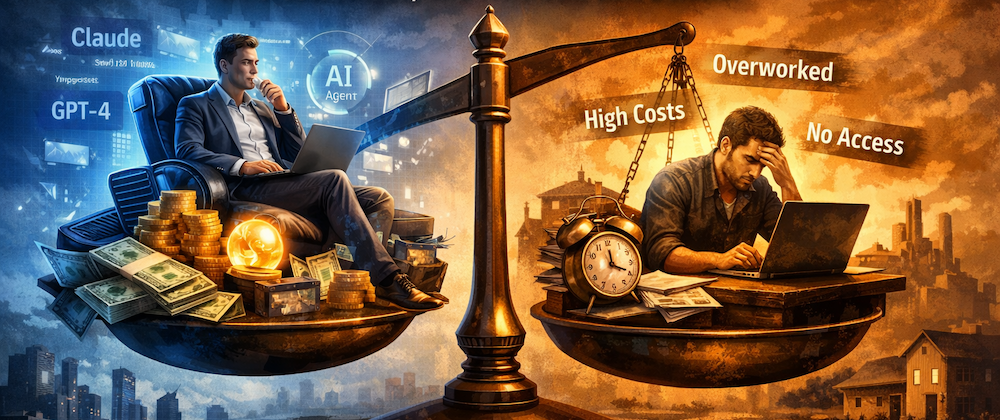
🤔 The thing about how much AI agents and tools have improved is that I’m finding myself in a weird spot. I’m always working. Even when I’m not working, I’m planning and brainstorming in Claude Projects so I can use the spec and plan files later in Claude Code.
In a recent interview with The Pragmatic Engineer, Mitchell Hashimoto, the founder of HashiCorp said his “new rule for building software: always have an agent running in the background doing something.” (link)
And while I love this in theory, and I find myself doing this to some extent, I’m already worried about burnout and this “always on” mindset.
🛠️ And here’s the other thing: I wish I trusted these agents enough to run things while I sleep. But right now, I don’t trust them to do more than plan without my input. Unlike the vibe-coding tech bro CEOs, I actually care about putting out quality work.
💸 But it’s not just the burnout and trust concerns. When people like Hashimoto say these things, they’re ignoring the simple fact that not everyone can afford $200/month for Claude Max 20x plan, let alone multiple model, agent, and tool subscriptions.
🎯 The problem with the AI industry, like most capitalistic endeavors, is that it ends up mostly benefiting those who need the benefit the least.
This creates a new kind of productivity inequality. The “always be shipping” hustle culture we thought we escaped is back, but now it’s “always have agents running” — and it comes with a subscription fee most developers can’t afford.
A well-off founder can afford multiple AI subscriptions and always-on agents. A developer in San Francisco can expense these tools. A startup with VC funding can buy every seat they need.
But the person trying to break into tech from an underserved community? The self-taught developer working two jobs? The talented engineer in a developing nation? They’re priced out of the “revolution.”
⚖️ So we’re facing multiple problems:
- The mental health cost of never being truly off
- The financial barrier to even participate in this new “baseline” of productivity
- The gap between the hype and what these tools can actually deliver unsupervised
Nice idea in theory. But maybe not exactly a good one in practice.
And I’m left to wonder: when did we decide that being a good developer means never sleeping, having deep pockets, and abandoning quality standards?
⚡ Some are saying the barrier is lowered. Some are saying this is an equalizer. Prove it.
What are you doing to put this technology in the hands of the common folk you claim benefit from it most?
Where are the:
- Free tiers that actually work for meaningful projects?
- Offline-capable models that don’t require constant API calls?
- Tools optimized for low-bandwidth, low-spec hardware?
- Pricing models that account for purchasing power parity?
Because right now, “democratizing AI” just means “selling subscriptions to people who can already afford them.”
That’s not disruption. That’s just a new premium service with better marketing.
If AI is truly the great equalizer, it should be accessible to everyone — not just those with deep pockets and Silicon Valley salaries.
Until then, stop calling it democratization and call it what it is: a luxury product for the already privileged.
Oops, I ranted again. Sorry. For real though, I’m hoping to spend some time on the PiForge side to really think about how to solve this. Also, I am well aware of how fortunate and blessed I am to be able to afford and use at least some of these tools. Which is why I’m trying to find ways to make them available to everyone.